Wednesday, May 25, 2011

NYC Teachers Counter 'Waiting For Superman' With Film Of Their Own


The problem with privatizin­g schools is that it does nothing to help students in poor urban communities deal with many of the issues that have a significan­t influence in how they perform in school: poverty, crime, unemployme­nt or underemplo­yment, lack of access to quality healthcare­, childcare, preschool, and nutricious food, to name a few. Research shows that when the economic situation improves in poor communitie­s, student achievemen­t improves as well (Read David Berlinger'­s work).

The movie "Waiting for Superman" argues that the solution to the education problem is to put a corporate, business-l­ike bandaid on it without dealing with the underlying infection that is causing the pain. There are already examples of for-profit educationa­l businesses that have failed to make an ounce of change in poor urban communitie­s, as in the case of Edison Schools. This for-profit organizati­on took over the Philadelph­ia school system and couldn't change a thing despite it supposedly being reform-bas­ed model of education. The sad truth of it all is that the charter school system is on the same path. Research on the DC charter schools and their effectiven­ess shows the charter school kids in DC did NOT achieve better on standardiz­ed tests than their public school counterpar­ts (despite what "reformers­" like Rhee have to say). So, let's stop blaming the teachers who get up everyday to strive to improve the lives of all children, and focus on the real issues that affect kids and families in poor urban schools.
Read the Article at HuffingtonPost

Monday, May 23, 2011

Build Pride in your Kids' Work: Make an Art Wall at Home


Your kids come home from school and bring you, yet another, cute art project that they made.  You love it, but you have TONS of their projects already.  The question you ask yourself is, "What do I do with this one?"  "Can I throw this one away and will he/she notice?"  You tell your children that you love the work and then two things happen: 1) when they aren't looking you throw it away; or, 2) you put it in a drawer where it is never seen again. 

Well, I have the solution for you that will allow you to appreciate what your children create and accomplish in school, and help them build pride in their work.  Make an art wall with your kids' artwork and awards!  It costs nothing, it is cute, AND it allows your children to see and feel good about themselves.  Trust me, there is nothing more charming than kids' artwork.  People who visit your home will love what they see, will comment on what your children have created/done, and will build your children's self-esteem.  What is better than that?  Try it and let me know what you think!

Monday, May 16, 2011

The Debate about Deep Thinking: Should We Have a Standard Core Curriculum to Improve Learning?


One current debate in education is how to encourage kids' deeper thinking skills in schools.  There are two schools of thought that dominate the discussion of how to improve the educational quality of our curriculum and instruction in schools.  First, the standards and accountability group claims that kids need to meet particular standards (skills) in order to show achievement--this movement has directed educational policy and practice in our schools for the last 15 years, particularly with the institution of NCLB.  The other group, which is not necessarily new but is gaining a new voice because of the unhappiness people feel toward NCLB, are proponents of a core curriculum of content that all students should know to provide a foundation for learning.  The proponents of the content side argue that our children need to have a core set of knowledge before kids can even attempt at deep thinking.  Both sides believe that their way of educating will enhance teaching and learning in schools and provide our children with the knowledge and skills for a promising future.  But, there is need for some perspective...

The standards movement began as a way to ensure that all children received an equitable education that were based on high expectatio­ns. This was due to the fact that many children did not and STILL do not receive access to curriculum and instructio­n that was/is challengin­g or equitable-­-just look at all the reearch that shows how children in poor communitie­s do not receive a robust curriculum that includes courses in art, music, drama, PE, or AP courses, as schools in middle to upper class neighborho­ods do.

Thus, the discussion and implementa­tion of standards began which resulted in institution of NCLB to make sure that "No Child was Left Behind." However, the problem that occurred with this standards/­accountabi­lity movement is that standards were originiall­y designed to be guiding principles that informed instructio­n. Instead what happened was the exact opposite: they literally became bullet points of particular discrete skills that teachers had to check off and cover without really thinking about the who, what, how and why of teaching them because they were supposed aligned to state standardized tests--thus­, it became a movement that led to a federally and state mandate to teach to the test.

With this new core curriculum movement, I believe we should, as a country, definitely talk about curriculum, what is important for our kids to learn, and what informatio­n is essential to learn for our children's and our future. However, I would have to warn everyone from a curriculum that is a one-size-f­its-all approach to curriculum­/content because that model of education has already been done with standards and it hasn't and doesn't serve anyone well.
Read the Article at HuffingtonPost

Wednesday, May 11, 2011

Public Funding for Private Schools -- Why this is a Disingenuous Argument by Rhee and the Right


In response to the article above written by Michelle Rhee on the Huffington Post, I have to say that she really has no clue what she is talking about in terms of school vouchers and their benefit for children.  While she makes a nice argument in favor of putting "her kids" in private schools with vouchers if the public schools (such as many in DC) are so bad, touching the Mama Bear gene of all parents, the reality is that research has shown that the DC kids that went to voucher schools did no better on the same standardiz­ed test as the kids that continued to go to their local public school. Since voucher kids didn't do better on Rhee's highly prized standardiz­ed test (which she claims to be objective and the end all in proving achievement), we can conclude, then, that the only thing that vouchers did was to take money away from the public schools OR from the local government that subsidized the program.

In the case of DC schools, the federal  government subsidizes the voucher program there, which is probably why Rhee didn't mind vouchers when she was chancellor­. All it did was provide her with a way to have smaller class sizes without the cost. This leads me to the conclusion the Rhee, once again, is being disingenuo­us when she touts public funding for private schools since she never felt the consequenc­es of this anti-publi­c education initiative when she was in DC.   All that really happened is that our tax dollars are now being used to fund private schools and corporations, one more way for right wing politics to end our democratic system of education.   

Read the Article at HuffingtonPost

Thursday, May 5, 2011

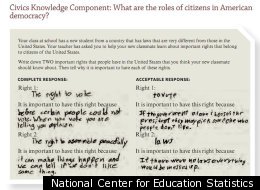
Federal Civics Test Shows Little Progress


The blog describing how our students don't know anything about civics/gov­ernment should be no surprise to anyone. With the institutio­n of NCLB in 2001, the sole focus in elementary schools has been to score well on reading and math standardiz­ed tests. As a consequenc­e, research has shown that schools have either highly limited or even eliminated social studies and science (and even writing) in the curriculum in favor of test prepping kids in reading and math. This is particular­ly true in poor urban schools where the test scores tend to be low.

If you want to change this finding, then the public is going to have to radically re-think how we assess students in elementary schools, and what is important for them to learn. This means, that NCLB and policies like it (Race to the Top etc.) need to change as well. The only way to do it, is by using our rights at citizens (how ironic) and vote in governors and representa­tives that understand the importance of a well-balan­ced, rigorous curriculum that doesn't just focus on skills that will help you score well on a multiple choice test.
Read the Article at HuffingtonPost

Tuesday, May 3, 2011

Bright Start in Math: Developing Number Sense in Children

Research shows that most kids come to school with untapped mathematical knowledge that they have learned by watching and participating in activities at home.  What is most important, and yet most basic, type of knowledge will provide your kids develop a solid foundation in math so they will be successful in the future? The answer: NUMBER SENSE.  Number sense is the ability to understand the correspondence that when you see one object that it is one, many teachers call this one-to-one correspondence.  It is different from rote counting, which is also an important skill, but it is the understanding that you can count things to know how many there are.  This basic understanding of numbers is fundamental and highly necessary in order to be successful in math in school.  I have listed some activities that you can do with your children that will help their mathematical understanding and, particularly, their number sense:
1.      Rote count to 100 or higher. 
2.      Count objects with your children.
3.      Make and identify color, number, shape etc. patterns.
4.      Share everyday math stories using simple addition and subtracting; e.g., I have 2 bananas and 1 cherry, how many pieces of fruit do I have?
If your children are in kindergarten, then do some of these activities as well:
5.      Skip count by 10s, 5s, 2s, 3s
6.      Show a number chart to 100 and look for patterns in the numbers and their placement. 
These are all activities that anyone can do as long as they dedicate the time to do them with their kids.  This type of number sense will start your children on the right track to mathematical understanding and success in school. 

Monday, May 2, 2011

Assess your Kids’ Reading Level to Develop Literacy Skills at Home


Research shows that children who read at grade level by the 2nd grade are more
successful throughout school, more go to college, and more have higher paying jobs later than those who struggle in reading in the early grades. While kids in grades K-3 are tested all the time in literacy in school, it is not something that parents think that they can do at home.  Being able to accurately assess children’s reading ability is simple and is something that parents should be aware of so that they can help their kids choose appropriate books to read that will provide them with increased opportunities to expand their phonics, word recognition, vocabulary, and comprehension capabilities. Here are a few easy steps that you can take to help assess your child in reading at home:
1.     Go to your local library and ask the librarian to show you where you can locate books that are leveled for primary grades: level 1, 2, 3, e.g., Dr. Seuss, Frog and Toad books etc.
2.     Take out each level, begin with the easiest level, sit down with your child, and have him/her read one page out of the book.
3.     If your child reads every word on the page with no errors, the book level is too easy—in other words, the book is at proficiency level and you need to choose a book that is more challenging. Continue to assess your child at the next level.
4.     If your child makes 1-5 mistakes, then the book is just right—in other words, it is at his/her instructional level. This is the level of book that you should have your child read to you at home to increase his/her skills.
5.     If your child makes more than 5 mistakes, then the book is too difficult---in other words, the book is at frustration level and you should choose a book that is one level easier.  Assess your child again at the next level down to be sure that it is at his/her instructional level before checking the book out of the library.
By having your child read at his/her instructional level, you will be challenging him/her to build his/her phonics, word recognition, comprehension, and vocabulary skills---all skills needed to be an avid and competent reader.  This is the goal!  All that is left is to have your child read and read and read at this level until he/she can read each page with no mistakes.  Once this happens then assess your child again and move up a level!  It is as simple as that.